There was a time when being a photographer meant mastering light, composition, and timing. Those elements still matter. They always will. But today, they are no longer enough. We live in a world where everyone carries a camera. Images travel faster than context. Stories circulate before they are verified. The visual space is saturated. In this environment, the true differentiator is no longer technical ability alone. It is credibility. It is clarity. It is a structure.
The modern photographer operates in a landscape that demands more than talent. Institutions ask for identification. Event organizers request formal documentation. Editors evaluate not only the image, but the person behind it. Audiences question authenticity. The profession has evolved from craft to responsibility.
And responsibility requires infrastructure.
Many independent photographers discover this gradually. At first, the focus is on building a portfolio. Then comes the need for access — to events, to restricted areas, to official environments. Questions begin to appear. How do you present yourself professionally? How do you demonstrate legitimacy without belonging to a traditional newsroom? How do you communicate that your work follows ethical standards? How do you show that you are not simply another content creator chasing visibility?
Without a professional framework, even strong photographers find themselves navigating uncertainty.
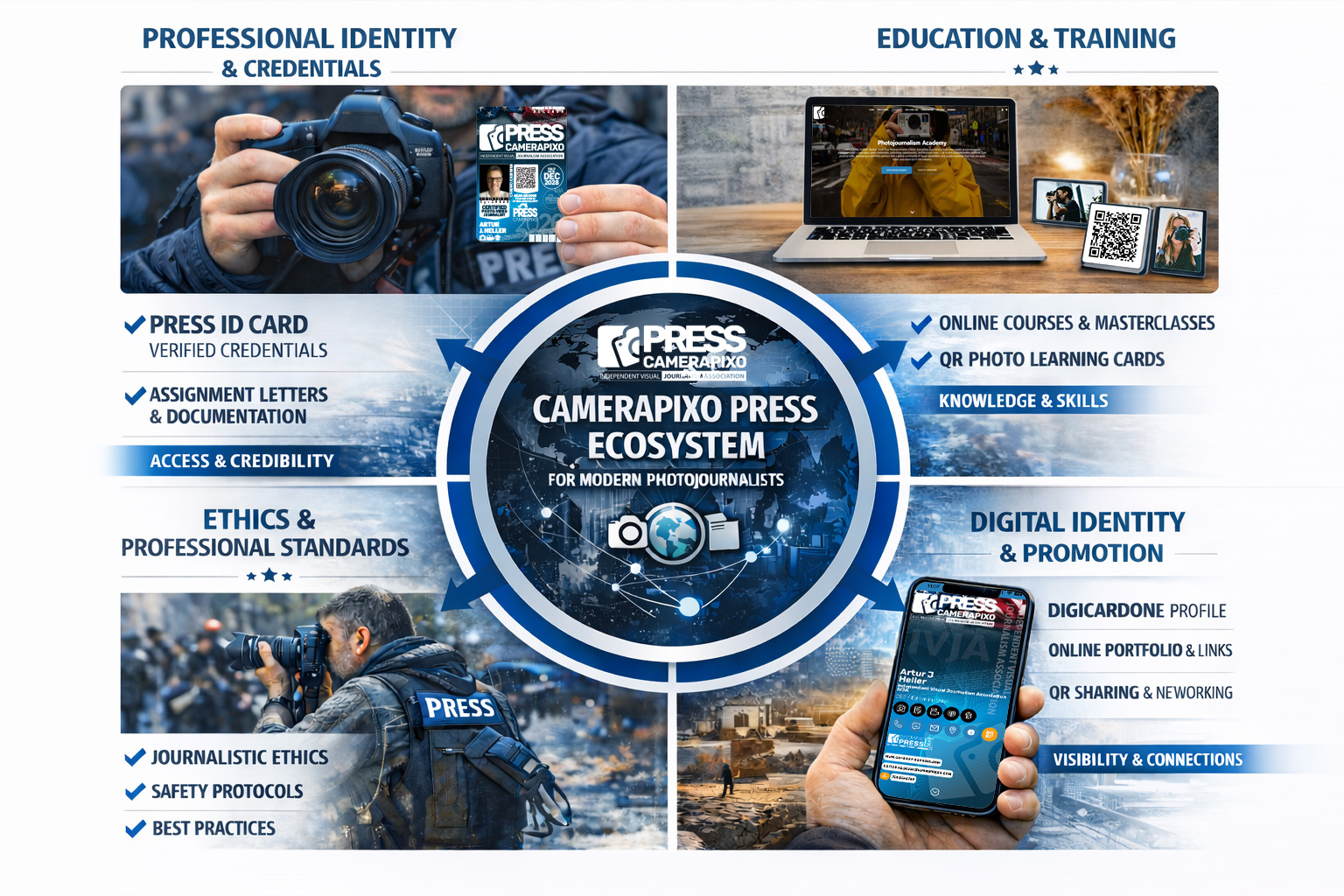
The Camerapixo Press Ecosystem was created as a response to that reality. Not as a product. Not as a marketing tool. But as a structured environment where independent visual journalists can operate with clarity and professional grounding. At its core, the ecosystem recognizes something fundamental: in modern visual storytelling, credibility functions as currency. It determines access. It influences trust. It shapes opportunity. And credibility does not emerge accidentally. It is built through a consistent structure.
A verified professional identity becomes more than a card or a badge. It becomes a signal. It communicates intent, seriousness, and alignment with professional standards. When connected to an online verification layer and supported by formal documentation tools, it transforms from a symbolic gesture into an operational asset. It reduces friction when approaching institutions. It clarifies positioning in uncertain environments. It strengthens confidence in conversations that matter.
But identity alone is insufficient without knowledge.
The modern photojournalist faces complex ethical decisions in real time. What should be shown? What should remain unseen? When does documentation become an intrusion? When does editing distort meaning? These are not abstract questions discussed only in classrooms. They arise in the field, often under pressure.
That is why education within the ecosystem is not presented as optional enrichment. It is treated as operational preparation. Structured learning modules, reflective materials, and field-oriented guidance exist not to add theory, but to sharpen judgment. They help photographers think clearly before, during, and after moments that carry public significance.
Professional development becomes continuous, not reactive.
Equally important is digital presence. In today’s environment, a photographer is often evaluated long before direct contact occurs. Editors search. Institutions verify. Collaborators review. A fragmented online identity can undermine even excellent work. A structured professional profile, aligned with ethical positioning and verified identity, creates coherence. It presents the photographer not as a random account in an algorithm-driven feed, but as a professional operating within a defined framework.
What makes the Camerapixo Press Ecosystem distinct is not any single element. It is the integration. Identity connects to education. Education reinforces credibility. Credibility strengthens digital presence. Digital presence supports access. Each layer reinforces the others.
This interconnected structure reflects the realities of modern journalism. Independence no longer means isolation. Freelance photographers, mobile reporters, and documentary storytellers must build their own operational foundation. Traditional newsroom backing is no longer guaranteed. The responsibility to construct a professional infrastructure falls on the individual.
The ecosystem offers that foundation without limiting autonomy. It does not dictate creative direction. It does not impose stylistic boundaries. Instead, it provides stability — a framework within which independent work can grow stronger.
The question for modern photographers is not whether they can create compelling images. Many can. The deeper question is whether they are prepared to operate professionally in environments that demand accountability, clarity, and trust.
Infrastructure is no longer a luxury reserved for large media organizations. It has become a strategic necessity for individuals.
The Camerapixo Press Ecosystem exists for photographers who understand that their career is not built on images alone, but on the system that supports them. It exists for those who recognize that credibility must be cultivated, not assumed. It exists for creators who want their independence reinforced by structure rather than weakened by fragmentation.
In a saturated visual world, talent may attract attention. But structure sustains careers. And in modern visual storytelling, credibility — supported by a professional ecosystem — is what turns opportunity into longevity.