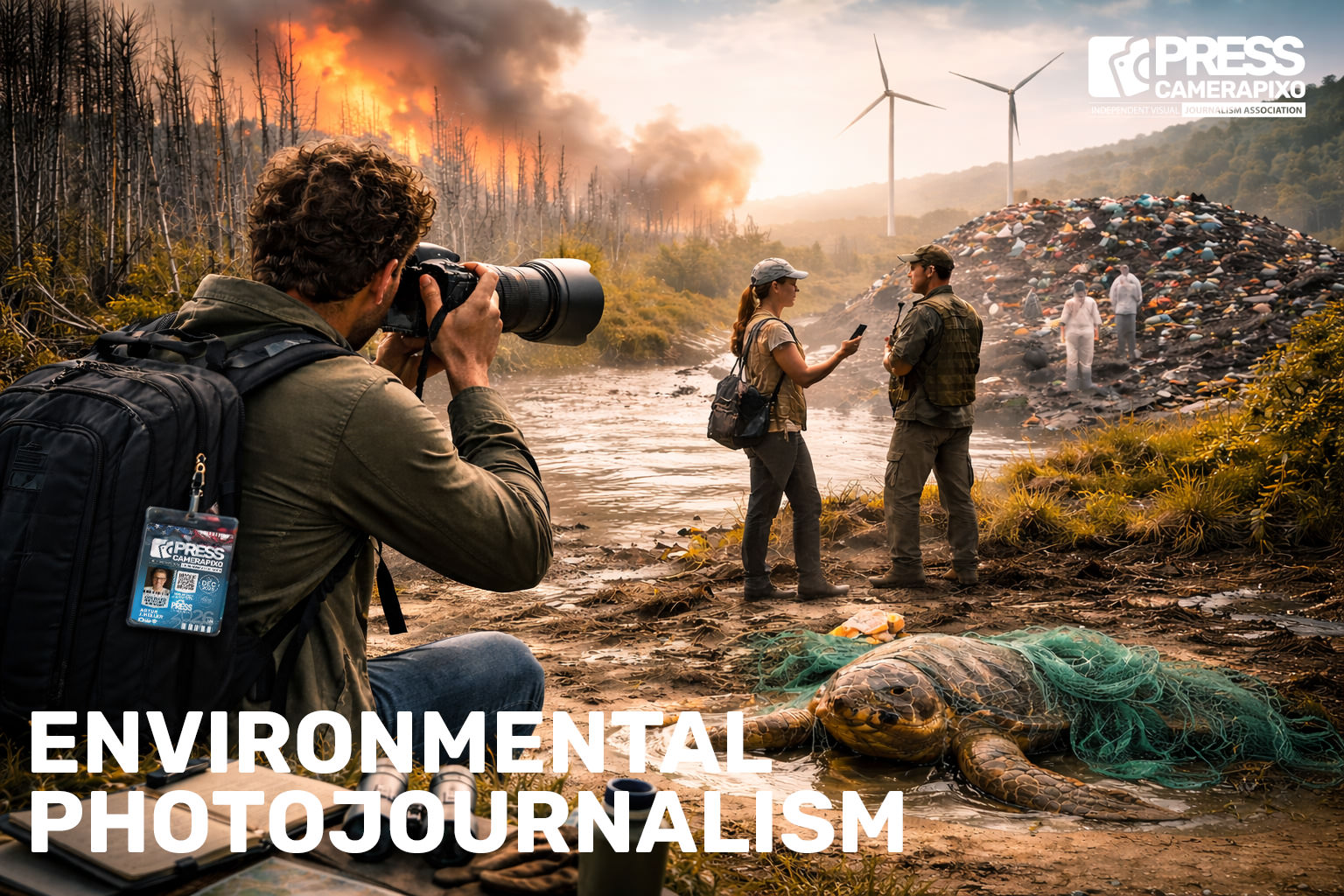
Environmental journalism is a field of reporting focused on nature, climate, ecosystems, and the impact of human activity on the planet. It goes far beyond “writing about ecology.” It is full-scale journalism — grounded in evidence, accountability, and public service — aimed at helping society understand what is happening to the environment and why it matters.
In a world where climate change accelerates, disasters become more frequent, and ecosystems reach critical thresholds, environmental journalism has become one of the most essential branches of modern media. It not only informs — it documents, verifies, and preserves truth for the public record.
Environmental reporting also plays a critical role in cutting through confusion and misinformation. Environmental topics are often surrounded by political pressure, corporate narratives, and simplified headlines that miss the real story. A strong environmental photojournalist does the opposite: they slow down, verify the facts, and build stories that help people understand causes, consequences, and responsibility.
What makes this field unique is its long-term perspective. Environmental journalism documents processes that unfold over years — rising temperatures, disappearing species, shrinking water resources, or the slow transformation of communities affected by pollution. These stories may not always feel “urgent” in the moment, but they shape the future more than many daily news headlines ever will.
Most importantly, environmental journalism gives voice to realities that are easy to ignore until they become impossible to escape. It connects global issues to local lives, showing how environmental change affects families, cities, jobs, health, and safety. When done well, it becomes a form of public service — reminding us that the environment is not a separate topic. It is the foundation of everything we depend on.
What Does Environmental Journalism Cover?
Environmental journalism is broad and interdisciplinary. It blends science, data, policy, economics, and human stories. Key areas include:
- climate change and extreme weather
- natural disasters and long-term consequences
- air pollution, toxins, and public health impacts
- endangered species and biodiversity loss
- deforestation and land degradation
- plastic pollution and ocean contamination
- industrial impact, mining, and energy production
- water access, land conflicts, and resource shortages
- green technology, sustainability, and real-world outcomes
- corporate environmental PR and greenwashing
Environmental journalism often intersects with politics and industry, which makes it one of the most complex and high-responsibility fields of reporting.
Environmental Journalism and Photojournalism – Why Photography Matters
Environmental journalism relies heavily on visual documentation. Photography is not simply an illustration — it is evidence. Environmental photojournalists often capture realities that are difficult to describe with words alone:
- rivers drying up and lakes disappearing
- forests damaged by fire, disease, or illegal logging
- wildlife suffering from habitat loss or drought
- floods, evacuations, and destroyed communities
- polluted coastlines, landfill zones, and toxic sites
- the human consequences of industrial decisions
A powerful environmental photograph can communicate urgency, scale, and truth instantly. It creates public awareness, and in many cases, it becomes a historical record.
The Core Principles of Environmental Journalism
This field demands credibility. The topics are sensitive, politically charged, and often emotionally heavy. That is why professional standards matter even more than usual.
1) Document facts, not narratives
Environmental journalism should never start with a conclusion and then search for proof. The process begins with observation, evidence, and verification.
2) Verify sources like investigative reporting
Scientific research, public records, official documents, and expert interviews must be cross-checked. Accuracy is non-negotiable.
3) Show scale without emotional manipulation
Environmental stories are naturally emotional, but strong reporting relies on truth — not exaggeration. The most impactful work is powerful because it is real.
4) Protect people and places
In certain cases, publishing exact locations can cause harm — especially in protected wildlife areas or sensitive ecosystems. Ethical judgment is part of professional skill.
Is Environmental Journalism Only for Big Newsrooms?
Not anymore. Environmental reporting has become a key opportunity for independent journalists and freelancers because:
- many newsrooms have limited budgets for field reporting
- local communities need documentation of local environmental problems
- NGOs often publish documentary-style environmental reports
- thematic and independent digital publications are growing
For independent photographers and documentary creators, environmental journalism is a meaningful and future-focused career path.
Environmental Journalism and Press ID Cards – Do Press IDs Matter?
Yes — but it’s important to describe this professionally and honestly. A Press ID Card is not a universal access pass, and it does not replace government accreditation. However, for environmental photographers working in the field, it can be a highly practical tool — especially when documenting real-world situations in public spaces, local communities, and complex environments. Press IDs help in one key area: credibility and communication.
How Can a Press ID Help an Environmental Photojournalist?
1) Faster communication in the field
- Environmental journalists often interact with:
- park staff, rangers, or forest officials
- private landowners and local managers
- residents affected by environmental problems
- volunteers and community organizations
- local authorities and public services
A Press ID helps you explain who you are in seconds: “I’m not a random tourist. I’m documenting this story professionally.” That small detail can completely change the tone of the interaction.
2) Stronger credibility for freelancers
- Environmental topics are often surrounded by suspicion and controversy, including accusations of:
- activism instead of documentation
- manipulation or misinformation
- sensational storytelling
Having a Press ID linked to a journalism association such as Camerapixo Press – Independent Visual Journalism Association (IVJA) can support your professional identity and make it easier to:
- request interviews
- explain your mission clearly
- ask for permission to photograph
- build trust with people on location
3) Support in tense or uncomfortable situations
Environmental journalism can lead photographers into difficult terrain — physically and socially:
- industrial areas and restricted zones
- protests, conflicts, or public tension
- illegal dumping or environmental violations
- controversial development projects
In such cases, a Press ID can help de-escalate confusion and show you are acting in a professional capacity. It won’t solve every situation — but it often reduces friction.
4) Professional identity for publications and partnerships
Environmental photographers publish in:
- independent magazines
- documentary platforms
- local media outlets
- NGO publications (in documentary/reportage format)
- digital magazines and flipbooks
Press IDs can strengthen a professional profile when approaching editors, platforms, or organizations.
Who Benefits Most from a Press ID in Environmental Journalism?
A Press ID is especially useful for:
- freelance environmental photographers
- documentary storytellers and photo essay creators
- photographers building a publication-ready portfolio
- journalists collaborating with local organizations and communities
- visual journalists working at the intersection of nature and social impact
Why Environmental Journalism Matters
Environmental journalism is one of the most important areas of modern reporting because it deals with the long-term survival and stability of society. It is a field where truth matters, accountability matters, and visual evidence matters. It combines science, human stories, public impact, and ethical responsibility — and it creates work that can truly influence public awareness and decision-making. For photographers working in this field, professional tools that support credibility and safety are essential. A Press ID card is not a guarantee of access — but it can be a strong, practical element of professional identity, communication, and trust in the field.
Where to Take Your Environmental Story Idea
If you have an environmental story idea worth documenting, don’t keep it only as a personal project. Start by reaching out to the people and institutions closest to the issue. Local environmental organizations, wildlife rescue groups, park services, research teams, community leaders, and citizen activists often know where the real stories are unfolding — and can help you verify facts, access locations, or connect with affected communities. In many cases, they can also provide context that makes your reportage more accurate: timelines, previous incidents, official documentation, and the voices of those directly affected.
As your project develops, consider connecting with the editorial side of the industry. Editors of documentary or environmental publications, local newsrooms, university media departments, and NGOs that publish public-interest reports can help you turn a strong lead into a publishable story. They may guide you on what angle is most newsworthy, what visuals are missing, what ethical risks to consider, and how to structure your reporting for publication. Many impactful environmental stories begin with one message, one conversation, and one verified lead — then grow into a full visual reportage that makes a difference.